

A NEW COURSE BY PASQUALINO FRACASSO
Urban Watercolor: How to Paint a City Without Painting Everything
You paint every window and every car, and the street still goes flat. Pasqualino Fracasso reduces the scene to three or four masses, lets the dark layer dry, then removes pigment to bring the light back.
3 paintings. 5 video lessons. Nearly 4 hours. Lifetime access

At a Glance
Pasqualino Fracasso · Signature member, American Watercolor Society and National Watercolor Society · Awarded at NWS Los Angeles and SWA Texas · Published in The Art of Watercolor and Watercolor Artist
"You have to know the rules very well before you break them and go further." Pasqualino Fracasso
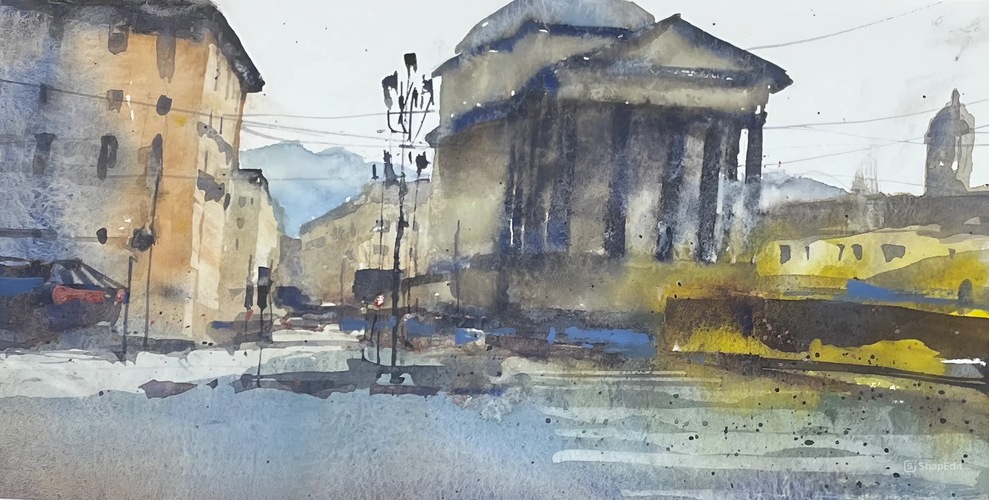
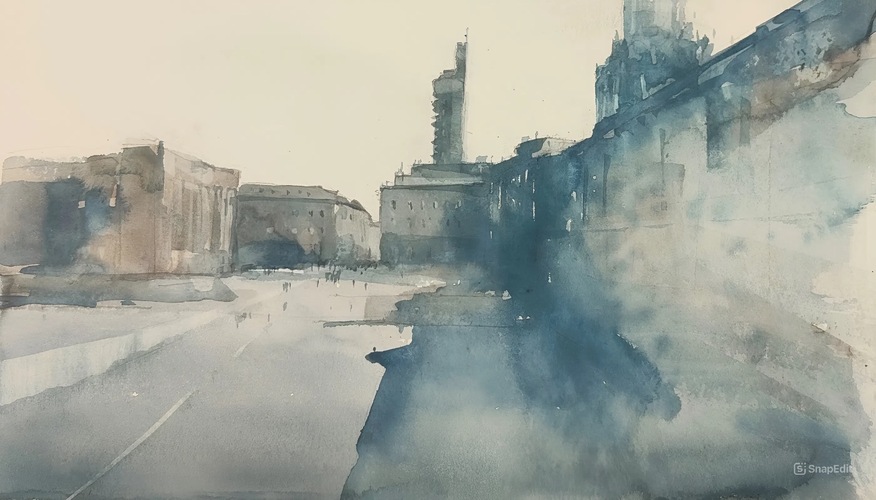
Pasqualino builds the scene from large masses, then takes color away. Windows, cornices, clouds and the light on the street appear when he removes pigment from a dried layer. The lights arrive as a decision at the end, not as white paper you protected from the first wash.
Is this right for you?
Every painter below walks away with a specific skill from this course.
The buildings lean, the street narrows too fast, the windows drift. You correct by eye and it still feels wrong. You need to read the perspective that already exists in your photo.
Signs, balconies, wires, cars, and all of it looks necessary. You keep everything, the work turns into a list, and the cars still float above the road. You need a rule for what carries the scene.
You follow the demonstration and the result holds. Then you open your own reference and the method stops working. You need the order of decisions, not the order of steps.
You save every white shape from the first wash and work around it, and the painting ends up careful and dull. You need a way to put light back into a dark layer.
Pasqualino's approach
- He paints the city in two moves: decide what to leave out, then take the light back out.
- Pasqualino starts with light pencil lines and marks for the main masses, not for objects. He fixes the horizon line first and keeps only what defines the scene, the silhouette of the buildings and the shadow pattern on the street. Cars and people are evoked with a few marks and reflections.
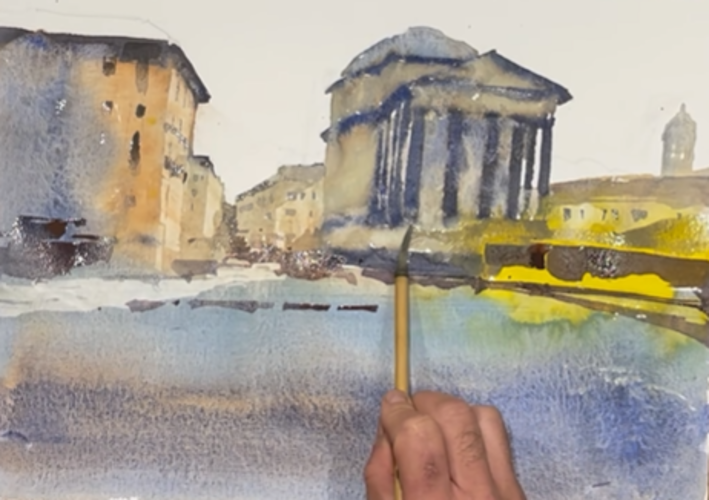
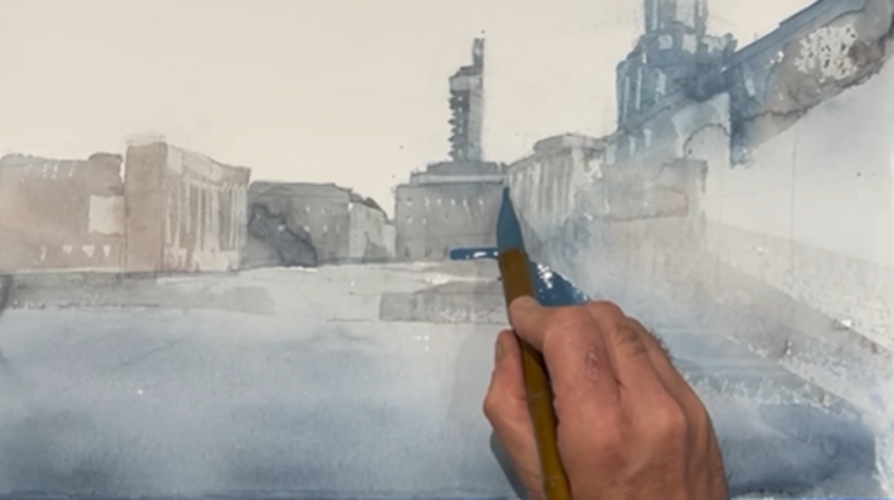
- Then he lays the dark layer and works backwards, removing pigment with water, paper and a wet brush. The order of decisions stays the same on any photo you bring.
I don't leave too much white space, because with the lifting technique I can remove the color.
Course program
Lesson 1. Analyze and Simplify the Main Elements. Torino
A street with a colonnaded church, traffic and light coming from the right. You choose which elements define the scene and which ones only fill space, then evoke cars and people with marks. Lifting brings back the light on the street.
1 h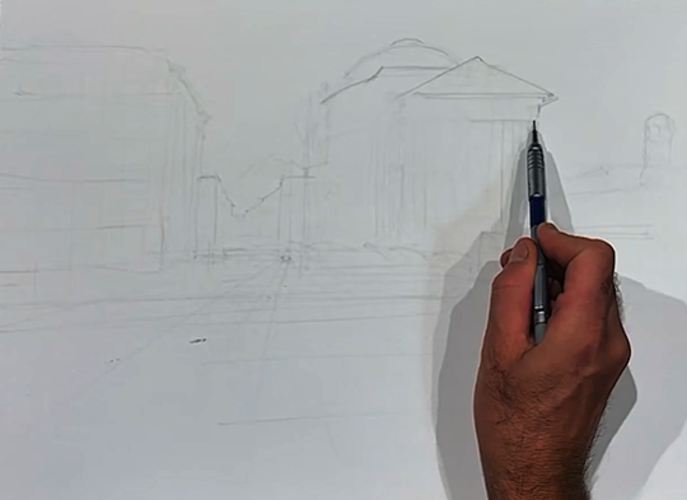
Lesson 2. Composition in Two Colors
A wide view taken from a window above street level, with heavy masses on the right and a road running to the focal point. Two colors only, so nothing hides a weak composition. You work on mass, rhythm and balance.
45 min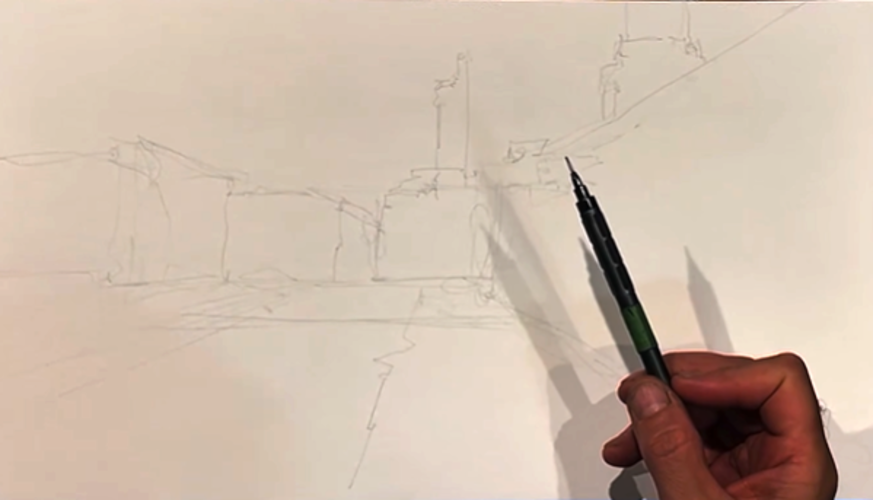
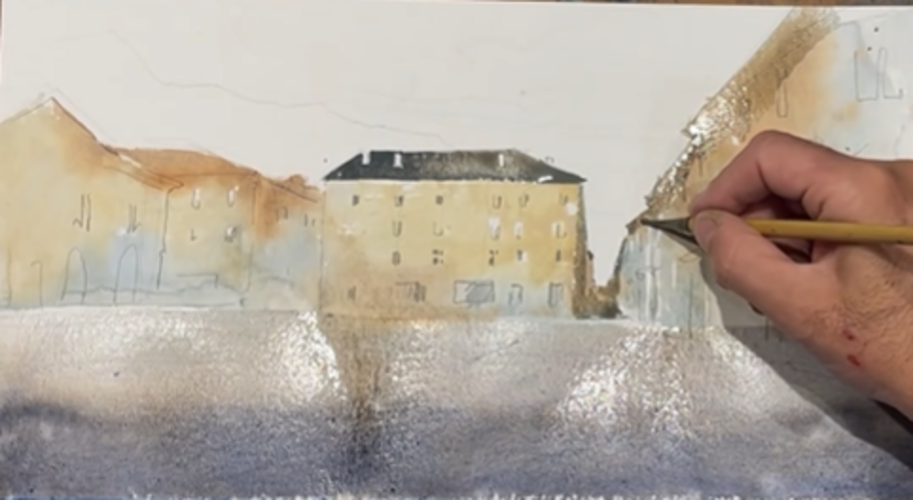
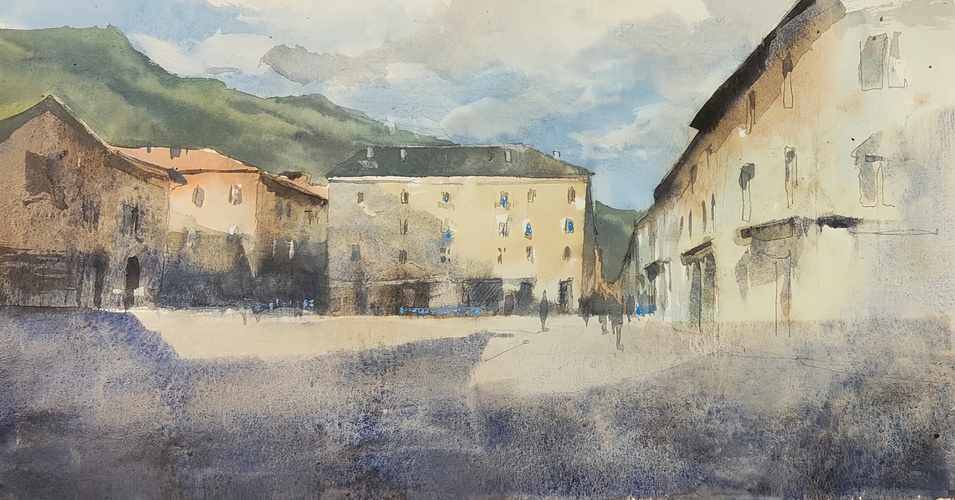
Lesson 3. A Composition Stronger Than the Photo. Aosta (Two parts)
A square with buildings on both sides and mountains behind them. You set the eye level from the figures, change the shadows from the reference, and balance the facades against the sky. Lifting creates windows and movement at the end.
1 h 28 min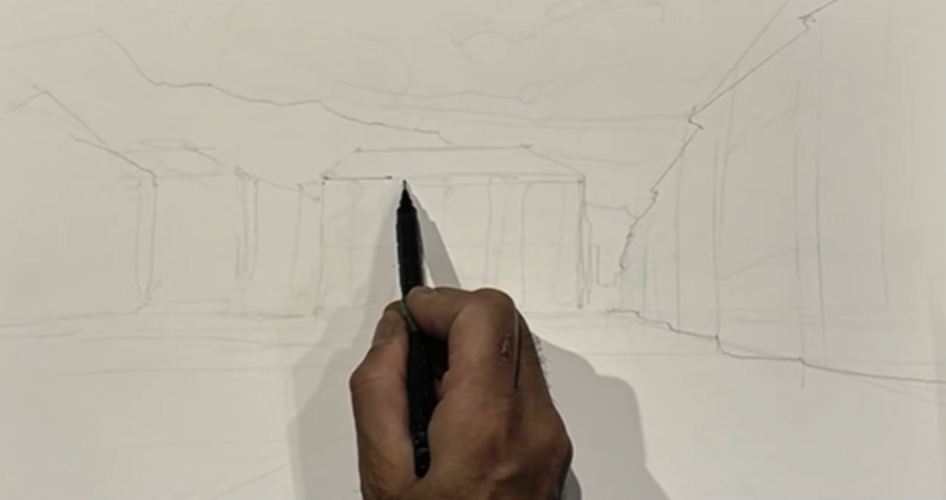
Lesson 4. Bonus: Perspective You Can Check.
Theory, no painting. Horizon line, eye level, vanishing point, and the proportion of every element against them. Pasqualino shows the mistakes that break an urban scene and explains how to read a photo before you touch the paper.
35 min


Lesson sample
What you will paint
Three Italian scenes, Torino, Aosta, and a view from above. The same method against three problems: simplification, mass, composition.


Meet Your Instructor
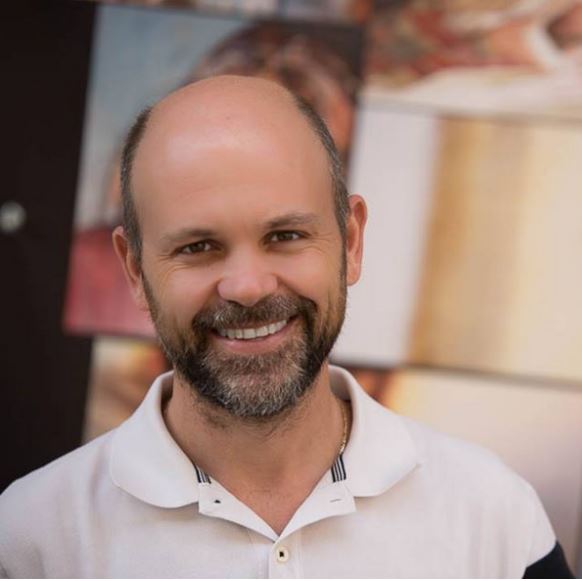
Pasqualino Fracasso
“Every time I paint, it is a challenge, a search for myself and for the beauty of the world around me.” Pasqualino Fracasso
- Invited to teach workshops and demonstrations across the USA, Europe and Asia, and to judge international exhibitions.
- Three awards at the National Watercolor Society International Exhibition, Los Angeles, 2020, and the Pittsburgh Excellence Award there in 2015.
- First Place at the Society of Watercolor Artists International Juried Exhibition, Texas, 2013, and the CCP Award at Watermedia International, Colorado Springs, 2011.
- Selected four times for the American Watercolor Society International Exhibition in New York, in 2014, 2017, 2018 and 2020.
- Featured in Konstantin Sterkhov's book Master of Watercolour and in The Art of Watercolor magazine.


What you will achieve
Perspective you can check
You read the horizon line and the vanishing point in your own photo before the first line.
A rule for what to leave out
You keep the elements that carry the scene and drop the rest without losing the city.
Light placed on purpose
You remove pigment from a dried layer and put the light where the composition needs it.
Urban elements that sit in the scene
Cars, people and signs are evoked with marks and shadows instead of painted one by one.
A composition stronger than the reference
You change the shadows and the masses to build a better scene than the photo gave you.
A method that transfers
The same order of decisions works on any street you photograph, not only on the three here.
Support and feedback
You do not paint alone. On Premium you get personal feedback on your work from a curator, plus a community around you, so a hard spot becomes a question you can ask, not a wall you hit.
Individual written feedback
- Three detailed reviews of your finished paintings plus one creative assignment, within your first 75 days. Written by a professional curator — what worked, what didn't, what to change on the next sheet.
- Premium plan.

A moderated community on WhatsApp
- Daily conversation with painters working through the same four elements. Questions, work in progress, honest reactions. Moderated by our community team.
- All plans.

Certificate of completion
- Issued when you finish the course. Recognition of your work — usable professionally if your work touches the arts, and worth having either way.
- Premium plan.

Student results
From painters who have worked with Pasqualino
Choose Your Plan
Plan
Standard
- 5 video lessons (total 4h)
- 3 final watercolor scenes
- 24/7 access from any location at your own pace
- LIFETIME access to the video lessons
- Access to the moderated students community on WhatsApp
- Final project (your own painting)
Bonus
- 30 ArtiCoins
Plan
Premium
- 5 video lessons (total 4h)
3 final watercolor scenes
24/7 access from any location at your own pace
- LIFETIME access to the video lessons
- Access to the moderated students community on WhatsApp
- Final project (your own painting)
- Official certificate of completion
- Individual written feedback from professional curator within 75 days
Bonus
- 40 ArtiCoins
Plan
City & Landscape Collection
- 8 video lessons (total ~7h)
6 final paintings
24/7 access from any location at your own pace
- LIFETIME access to the video lessons
- Access to the moderated students community on WhatsApp
- Final project (your own painting)
Course “From Dark to Light: a different approach to watercolor” by Pasqualino Fracasso
Bonus
- 60 ArtiCoins
Plan
Standard
- 5 video lessons (total 4h)
- 3 final watercolor scenes
- 24/7 access from any location at your own pace
- LIFETIME access to the video lessons
- Access to the moderated students community on WhatsApp
- Final project (your own painting)
Bonus
- 30 ArtiCoins
Plan
Premium
- 5 video lessons (total 4h)
3 final watercolor scenes
- 24/7 access from any location at your own pace
- LIFETIME access to the video lessons
- Access to the moderated students community on WhatsApp
- Final project (your own painting)
- Official certificate of completion
- Individual written feedback from professional curator within 75 days
Bonus
- 40 ArtiCoins
Plan
City & Landscape Collection
- 8 video lessons (total ~7h)
6 final paintings
- 24/7 access from any location at your own pace
- LIFETIME access to the video lessons
- Access to the moderated students community on WhatsApp
- Final project (your own painting)
- Course “From Dark to Light: a different approach to watercolor” by Pasqualino Fracasso
Bonus
- 60 ArtiCoins
Course “From Dark to Light: a different approach to watercolor” by
Pasqualino Fracasso
For "City & Landscape Collection" plan

Master a new way of seeing and painting landscapes through bold forms, lifting, and opaque layers even if you’re used to traditional watercolor rules. Learn to simplify, suggest, and correct and create 3 semi-abstract pieces with Pasqualino Fracasso
- 3 video lessons (total 2h 45min)
- 3 final scenes in unique author's technique
Value: $/€ 129
You have no risks
100% guarantee.
If after 1 to 2 lessons within the first week this approach is not for you, you get your money back. *within 14 days after payment
Freeze for Premium plan.
Start date not convenient? We freeze the course, once, free of charge.
Freedom and mobility
Access any time, at your pace, from a smartphone, tablet or laptop.
Materials

You probably have most of what you need.
Paints: French Ultramarine, Cobalt Blue, Royal Blue, Phthalo Blue, Burnt Sienna, Burnt Umber, Yellow Ochre, Naples Yellow Light, Cadmium Yellow, Hansa Yellow, Cherry Quinacridone, Titanium White.
Brushes: Chinese natural brushes in three sizes, a 40 mm flat synthetic brush, and a synthetic liner.
Other: paper towel and a clean wet brush for lifting, tape, and a hairdryer or heat gun to control drying.
Paper: Hahnemühle “Le Rouge” cellulose paper (325 g/sqm, cold-pressed). Alternatively, Hahnemühle “Bamboo” or “Britannia” (hot-pressed).
Each painting uses its own palette. The monochrome lesson needs three colors, Aosta needs six, Torino needs eleven. You will see why the number changes.
These are suggestions. Use what you already own.

FAQ
Still have questions?
Our team is here to help. Not sure which plan is right for you? Just reach out — we'll guide you in a few minutes.
Contact us
You stood in a square, saw the light cut across the facades, and photographed it to paint later. At home the scene turned into a list of objects, and the light was gone. It was never in the objects. It was in the two or three masses you covered and in the shadow you copied instead of changing.
“We evoke a lot of things, but the subject is the silhouette of this urban landscape.” — Pasqualino Fracasso