Urban Watercolor: How to Paint a City Without Painting Everything
You paint every window and every car, and the street still goes flat. Pasqualino Fracasso reduces the scene to three or four masses, lets the dark layer dry, then removes pigment to bring the light back.
3 paintings. 5 video lessons. Nearly 4 hours. Lifetime access
At a Glance
Pasqualino Fracasso · Signature member, American Watercolor Society and National Watercolor Society · Awarded at NWS Los Angeles and SWA Texas · Published in The Art of Watercolor and Watercolor Artist
"You have to know the rules very well before you break them and go further." Pasqualino Fracasso
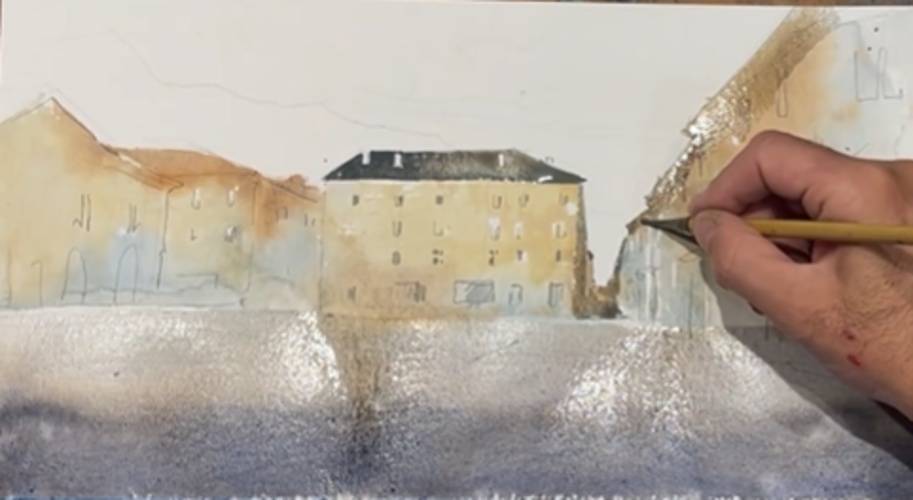
Pasqualino builds the scene from large masses, then takes color away. Windows, cornices, clouds and the light on the street appear when he removes pigment from a dried layer. The lights arrive as a decision at the end, not as white paper you protected from the first wash.
Is this right for you?
Every painter below walks away with a specific skill from this course.
The buildings lean, the street narrows too fast, the windows drift. You correct by eye and it still feels wrong. You need to read the perspective that already exists in your photo.
Signs, balconies, wires, cars, and all of it looks necessary. You keep everything, the work turns into a list, and the cars still float above the road. You need a rule for what carries the scene.
You follow the demonstration and the result holds. Then you open your own reference and the method stops working. You need the order of decisions, not the order of steps.
You save every white shape from the first wash and work around it, and the painting ends up careful and dull. You need a way to put light back into a dark layer.
Pasqualino's approach
He paints the city in two moves: decide what to leave out, then take the light back out.
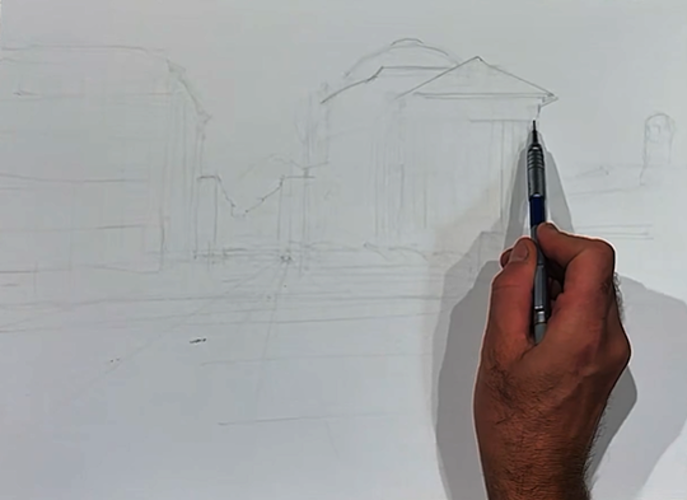
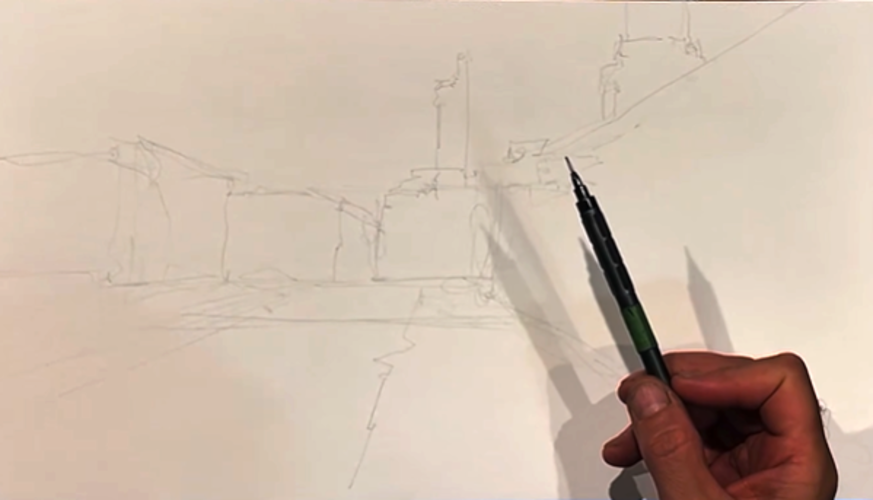
Pasqualino starts with light pencil lines and marks for the main masses, not for objects. He fixes the horizon line first and keeps only what defines the scene, the silhouette of the buildings and the shadow pattern on the street. Cars and people are evoked with a few marks and reflections.
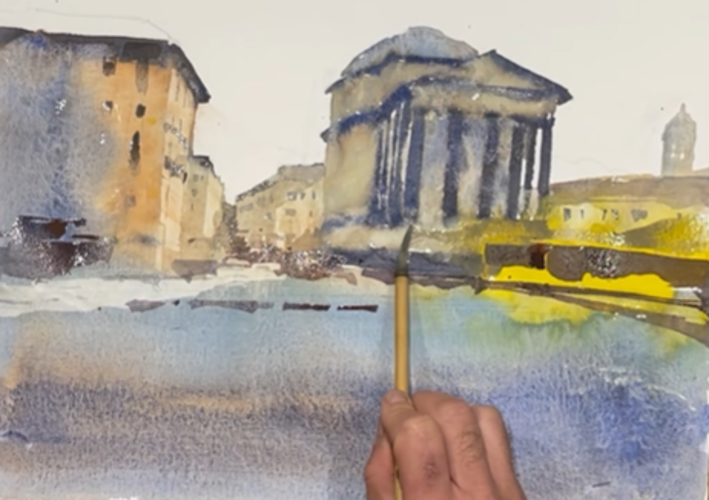
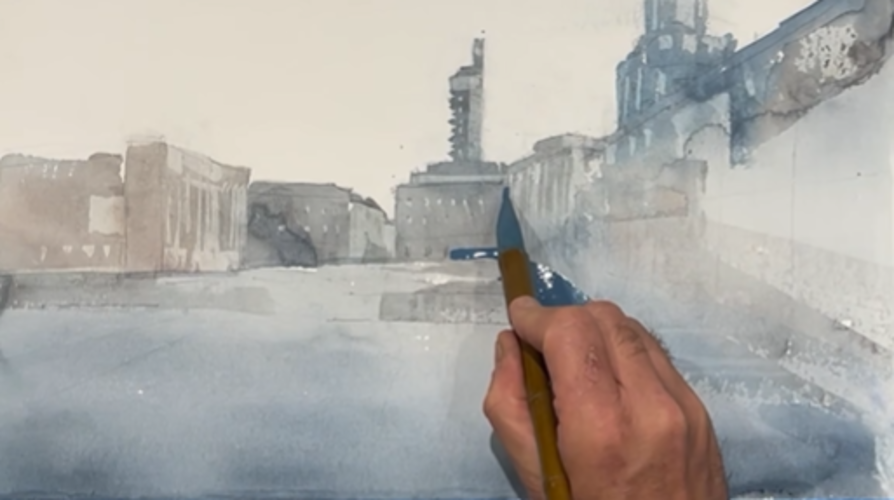
Then he lays the dark layer and works backwards, removing pigment with water, paper and a wet brush. The order of decisions stays the same on any photo you bring.
I don't leave too much white space, because with the lifting technique I can remove the color.
Pasqualino Fracasso
Course program
The method repeats. The subject and the problem change.
Lesson 1. Analyze and Simplify the Main Elements. Torino
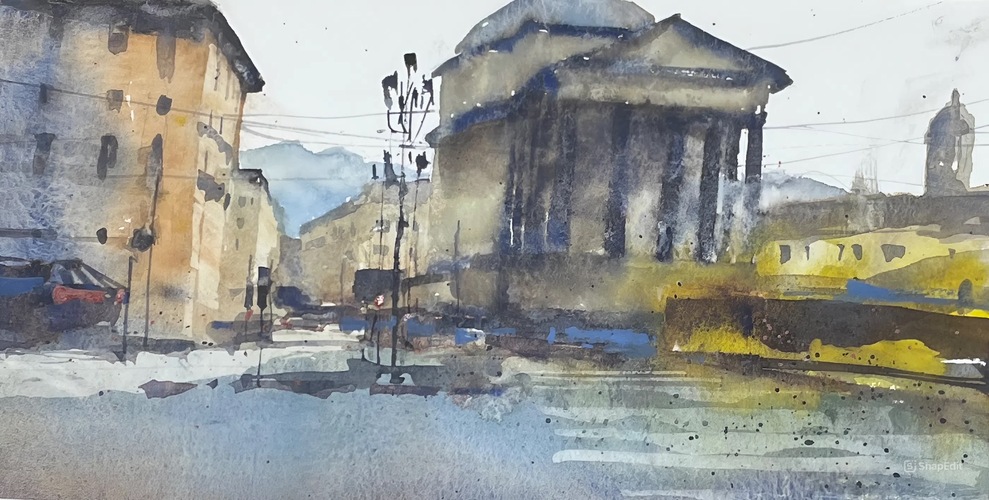
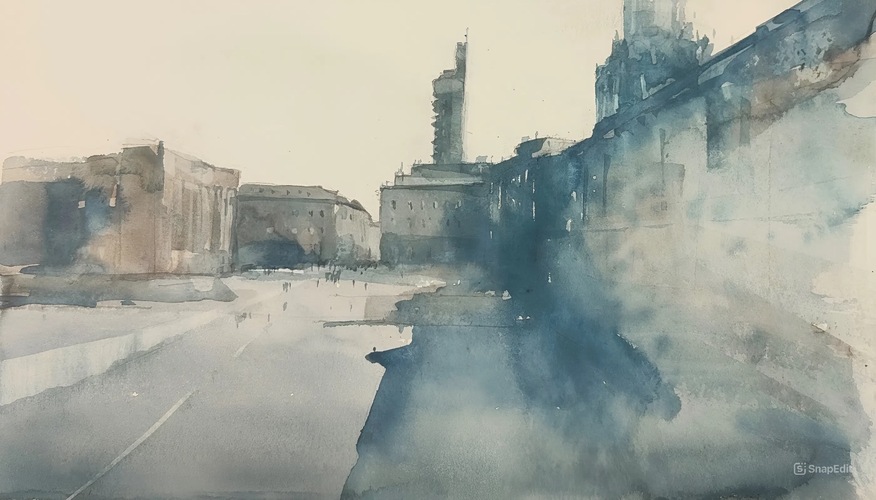
A street with a colonnaded church, traffic and light coming from the right. You choose which elements define the scene and which ones only fill space, then evoke cars and people with marks. Lifting brings back the light on the street.
1 h
Lesson 2. Composition in Two Colors
A wide view taken from a window above street level, with heavy masses on the right and a road running to the focal point. Two colors only, so nothing hides a weak composition. You work on mass, rhythm and balance.
45 min
Lesson 3. A Composition Stronger Than the Photo. Aosta (Two parts)
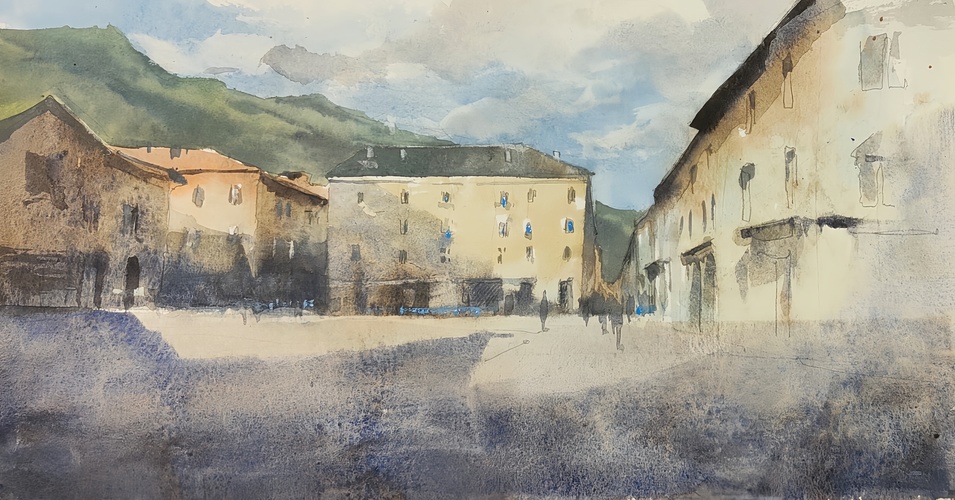
A square with buildings on both sides and mountains behind them. You set the eye level from the figures, change the shadows from the reference, and balance the facades against the sky. Lifting creates windows and movement at the end.
1 h 28 min
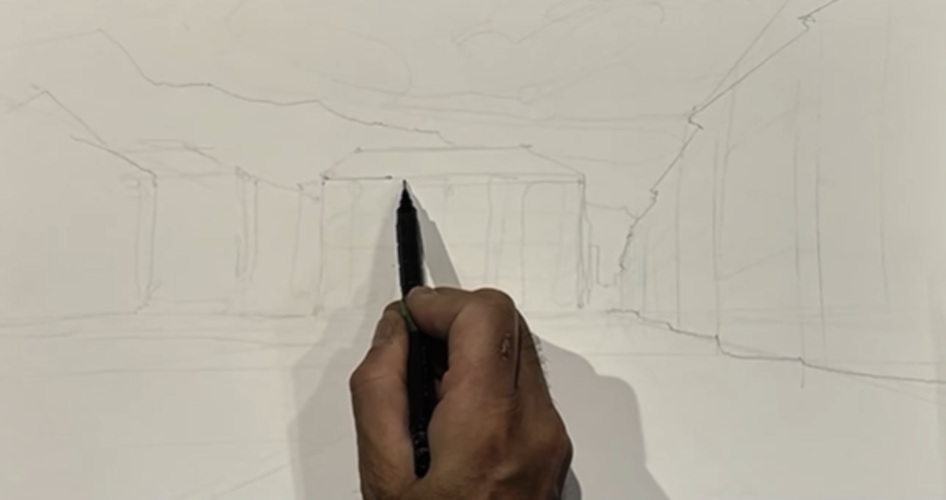
Lesson 4. Bonus: Perspective You Can Check.
Theory, no painting. Horizon line, eye level, vanishing point, and the proportion of every element against them. Pasqualino shows the mistakes that break an urban scene and explains how to read a photo before you touch the paper.
35 min
Lesson sample
What you will paint
Three Italian scenes, Torino, Aosta, and a view from above. The same method against three problems: simplification, mass, composition.
A street in Torino in warm light. Traffic evoked with marks and reflections, lights lifted back out of the facades.
A view from above in two colors. Composition carried by mass and rhythm, with the lights lifted from the dark layer.
A square in Aosta under a wide sky. The shadows are changed from the reference to strengthen the scene.
Meet Your Instructor
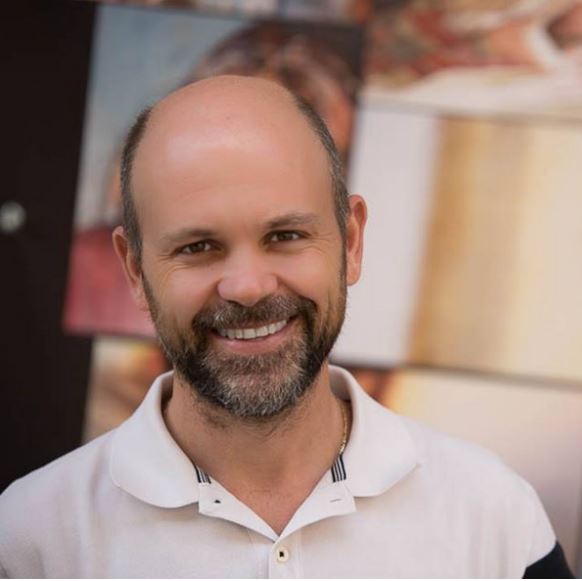
Pasqualino Fracasso
@pasqualinofracasso22k followers
“Every time I paint, it is a challenge, a search for myself and for the beauty of the world around me.” Pasqualino Fracasso
Invited to teach workshops and demonstrations across the USA, Europe and Asia, and to judge international exhibitions.
Three awards at the National Watercolor Society International Exhibition, Los Angeles, 2020, and the Pittsburgh Excellence Award there in 2015.
First Place at the Society of Watercolor Artists International Juried Exhibition, Texas, 2013, and the CCP Award at Watermedia International, Colorado Springs, 2011.
Selected four times for the American Watercolor Society International Exhibition in New York, in 2014, 2017, 2018 and 2020.
Featured in Konstantin Sterkhov's book Master of Watercolour and in The Art of Watercolor magazine.
What you will achieve
(01)
Perspective you can check
You read the horizon line and the vanishing point in your own photo before the first line.
(02)
A rule for what to leave out
You keep the elements that carry the scene and drop the rest without losing the city.
(03)
Light placed on purpose
You remove pigment from a dried layer and put the light where the composition needs it.
(04)
Urban elements that sit in the scene
Cars, people and signs are evoked with marks and shadows instead of painted one by one.
(05)
A composition stronger than the reference
You change the shadows and the masses to build a better scene than the photo gave you.
(06)
A method that transfers
The same order of decisions works on any street you photograph, not only on the three here.
Student results
From painters who have worked with Pasqualino
★ ★ ★ ★ ★
I`m so happy I have signed up for this course with Pasqualino. He is a great artist and a great teacher, explaining not only details but his way of thinking. I love the way he creates calm while the painting progresses.
Here is my first painting, working for the first time in 100 % cellulose A3. I had to adapt to this new big surface that reacts and dries in another way. My palette is slightly different, but I tried to follow the mixes as much as possible. I love the lifting technique!
This was an interesting assignment. I was glad to have an opportunity to try something of my own without a tutorial and still get some feedback. This was a great course and I learned a valuable new technique.
Thank you for this wonderful tutorial. My intention is not to copy your style but to learn new techniques that I can implement in my daily practice. I particularly enjoyed painting the trees, thank you for all your useful explanations!
Such an amazing class!!!!
I was a bit afraid of that yellow hill, and the lower part with all the lifting for the grass. I thought I would not manage. But it turned out to be a joyful experience. Pure freedom to let the water run, and then the splashes.I feel that I'm learning a lot in each class. And I love the references, and the way he transforms them.
It was a an experience par excellence to learn from P Fracasso , truly a visionary artist.The course was very well structured ,providing an experience in painting different types of scenes such as cityscapes, rural and countryside, which helped in skill development in painting different types of scenarios.The course was structured in such a way that there was an upward gradation in the skill level achieved after each lesson.
The guidance received after submission of the painting lesson, was really helpful in grasping and assimilation of essential painting skills intended to be achieved in that lesson.
My heartiest thanks to all at Artefacto.
Here is my latest work. I tried to keep the painting light and remember the things I learned. Thanks for the great course and guidance Terrilynn 😍
Reija K
★ ★ ★ ★ ★
Here is my creative attempt. I am still persevering on cellulose paper! I was hesitant at tackling this scene and thought it too ambitious but after hours of looking for a suitable photo, I came back to this one as it had all the elements I could work on following some of the tips from the previous lessons.
Paints: French Ultramarine, Cobalt Blue, Royal Blue, Phthalo Blue, Burnt Sienna, Burnt Umber, Yellow Ochre, Naples Yellow Light, Cadmium Yellow, Hansa Yellow, Cherry Quinacridone, Titanium White.
Brushes: Chinese natural brushes in three sizes, a 40 mm flat synthetic brush, and a synthetic liner.
Other: paper towel and a clean wet brush for lifting, tape, and a hairdryer or heat gun to control drying.
Paper: Hahnemühle “Le Rouge” cellulose paper (325 g/sqm, cold-pressed). Alternatively, Hahnemühle “Bamboo” or “Britannia” (hot-pressed).
Each painting uses its own palette. The monochrome lesson needs three colors, Aosta needs six, Torino needs eleven. You will see why the number changes.
These are suggestions. Use what you already own.
FAQ
Intermediate and advanced. You should be comfortable with basic washes and color mixing. Pasqualino explains the decision behind every mark, not only the mark itself, so the lessons hold whether you have been painting for two years or twenty.
Yes. He uses transparent and opaque mixes together on purpose, because an opaque layer holds the lifting better. You can follow every lesson with transparent colors only, and he says where the result will differ.
Yes. The principles hold regardless of manufacturer. Match the closest equivalent you own.
Lessons are pre-recorded. Watch whenever you want, as many times as you need.
The course is taught in English, with subtitles in six languages: English, Spanish, German, French, Italian, and Russian.
Choose a plan and click "Proceed to payment." Credit card or PayPal. Payments are processed securely. We never receive or store your card details.
You receive a confirmation email with a link to your learning account. Check Spam or Promotions if it has not arrived. Your purchased content appears in "Trainings / My Courses."
Still have questions?
Our team is here to help. Not sure which plan is right for you?
Just reach out — we'll guide you in a few minutes.
You stood in a square, saw the light cut across the facades, and photographed it to paint later. At home the scene turned into a list of objects, and the light was gone. It was never in the objects. It was in the two or three masses you covered and in the shadow you copied instead of changing.
“We evoke a lot of things, but the subject is the silhouette of this urban landscape.” — Pasqualino Fracasso