

A NEW COURSE BY YUKO NAGAYAMA
Paint With Water, Not Against It
See the method behind Yuko Nagayama's paintings, from shells to roses to a bouquet from life.
Let water, salt, and chance do part of the work, then control the result with a few clear decisions
Learn what to paint first and what to leave out, so a crowded subject reads clear, not muddy
Follow one method across three very different subjects, and take it to your own photos
3 paintings. 3 video lessons. 3.5 hours. Lifetime access

At a Glance
Loose watercolor looks like luck. Yuko's is a set of decisions you can learn.
Yuko Nagayama · Schmincke brand ambassador with two colors named after her, Peony Pink and Lagoon Blue · invited artist at Fabriano in Watercolour, Italy · author of more than a dozen watercolor books
“I don't touch it. The water and color play together, and I wait.” Yuko Nagayama
Her method is the same on every subject. She sets water, salt, and pigment moving and lets them run, then she decides four things: where the focus sits, which single color pulls the picture together, how far to layer for depth, and where to stop before the work turns heavy. Those four decisions are what you learn here.
Is this right for you?
Each painter below gets stuck at a different point. Find yours.
With the video on, it works. In front of your own reference the painting goes flat, and you do not know why. You need the decisions behind each mark, not the steps to copy.
The first washes look fresh. Then you add more, layer after layer, and the whole thing goes dull. You need to know what to leave out and where to stop.
You mean to save the light, then you paint over it and it is gone. You need to plan the white of the paper and protect it to the last layer.
Sometimes the water does something you love, sometimes it ruins the page, and you cannot control which. You need a way to set the water going and still decide the result.
Yuko's approach
- Yuko controls the painting by choosing what not to control.
- She floods the paper, drops in color, adds salt, and lets them run. She does not fix every bloom or edge. The accident stays in the painting, because a bloom or a grain of salt gives her texture she could not paint by hand.
- Then she takes control. She keeps one focal point clean, picks one color to hold the whole picture together, layers for depth only where the work needs it, and stops early everywhere else. The freedom you see rests on those four decisions, and that is why the same method carries from shells to roses to a full bouquet.

I keep one or two flowers, and let the rest go quiet
Course program
Lesson 1. Shells and Salt
Near-abstract shells on the seabed, built from water, salt, and layered color. You set the water working, save your whites, and pull a loose subject together with one main color.
50 min


Lesson 2. Roses by Candlelight
White roses and a lit candle against a deep background. You draw the rose from its structure, tie every shadow to the color of the background, and make a white flower read without painting it white.
1 h 30 min


Lesson 3. A Bouquet from Life
A full bouquet with fruit, painted from life, not a photo. You compose the setup first, choose one or two flowers to carry the focus, and build depth in layers without losing the light.
1 h 20 min


Lesson sample
Painters who studied with Yuko before say the same thing: they finally saw the decisions, not the result.
What you will paint
Three finished paintings, three different subjects, one method underneath.


Meet Your Instructor
Yuko Nagayama
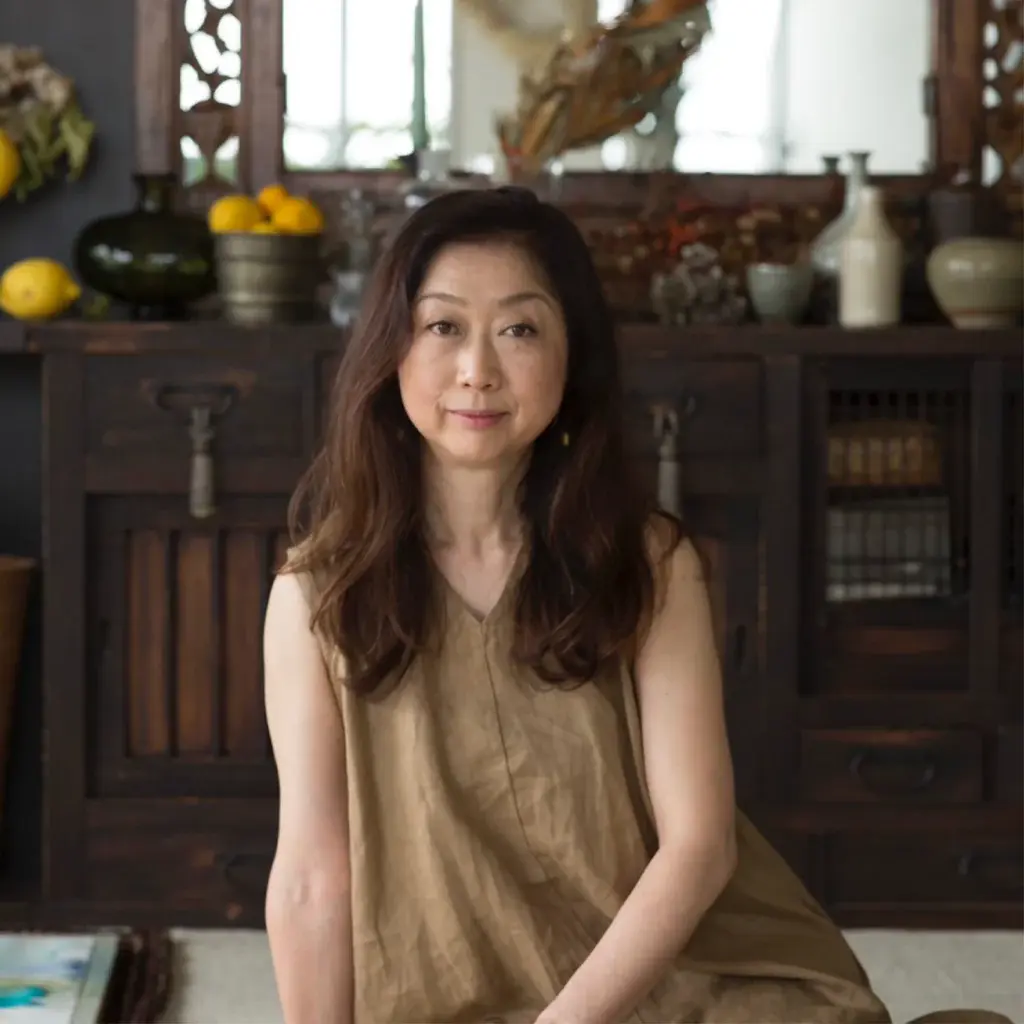
“I don't want to paint the flower exactly. I paint it the way I'd be happy to see it, alive.” Yuko Nagayama
- Born in Tokyo, 1963. Studied oil painting at Tokyo University of the Arts, graduate degree in 1987, and has painted in transparent watercolor since 1995.
- Visiting Professor at Saga University of Arts, and a former lecturer at Musashino Art University.
- Invited artist at international watercolor shows: Fabriano in Watercolour in Italy, the Biennale Internationale d'aquarelle in France, the World Water Media Exposition in Thailand, and International Watercolor Society exhibitions in Mexico, Hong Kong, and Vietnam.
- Solo exhibitions in Japan, Switzerland, Korea, and China.
"I paint from real flowers in front of me, in the morning light, never from a photo. I want you to see how I decide, so you can do it your way, not copy mine. That is what I want to show you here. "


What you will achieve
Start the water on purpose
You set washes, salt, and blooms going deliberately, instead of hoping they behave.
Keep control of the result
You make the few decisions that turn a loose start into a finished painting.
Save your whites and lights
You plan the white of the paper and protect it to the last layer.
Simplify a busy subject
You choose one or two points of focus and let the rest go quiet, so nothing turns muddy.
Mix clean color and real depth
You layer without mud, and mix your greens from yellow and blue, the way Yuko does.
Take the method to your own work
The same approach holds on any subject, from a still life to your own photo.
Support and feedback
You do not paint alone. On Premium you get personal feedback on your work from a curator, plus a community around you, so a hard spot becomes a question you can ask, not a wall you hit.
Individual written feedback
- Three detailed reviews of your finished paintings plus one creative assignment, within your first 75 days. Written by a professional curator — what worked, what didn't, what to change on the next sheet.
- Premium plan.
A moderated community on WhatsApp
- Daily conversation with painters working through the same four elements. Questions, work in progress, honest reactions. Moderated by our community team.
- All plans.

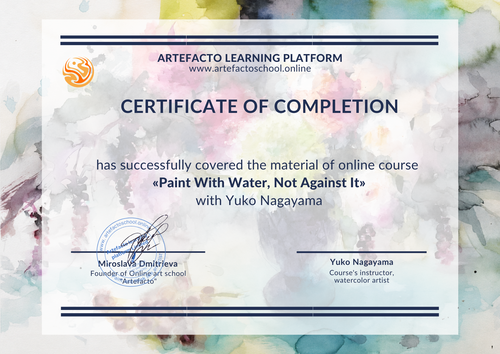
Certificate of completion
- Issued when you finish the course. Recognition of your work — usable professionally if your work touches the arts, and worth having either way.
- Premium plan.
What our students say about Yuko
Painters who studied with Yuko before say the same thing: they finally saw the decisions, not the result.
Choose Your Plan
Plan
Standard
- 3 Video lessons in full HD by Yuko Nagayma
- 3 Watercolor works by the end of the course
- 24/7 access from any location at your own pace
- LIFETIME access to the video lessons
- Access to the moderated students community on WhatsApp
- Final project (your own painting)
Bonus
- 30 ArtiCoins
Plan
Premium
- 3 Video lessons in full HD by Yuko Nagayma
3 Watercolor works by the end of the course
24/7 access from any location at your own pace
- LIFETIME access to the video lessons
- Access to the moderated students community on WhatsApp
- Final project (your own painting)
- Official certificate of completion
- Individual written feedback from professional curator within 75 days
Bonus
- 40 ArtiCoins
Plan
Collection
- 3 Video lessons in full HD by Yuko Nagayma
3 Watercolor works by the end of the course
24/7 access from any location at your own pace
- LIFETIME access to the video lessons
- Access to the moderated students community on WhatsApp
- Final project (your own painting)
- PLUS 1 additional full-length video lesson by Yuko Nagayama: “Delicate Watercolor Flowers”
The Collection plan includes 4 video lessons in total: 3 lessons from the new course
+ 1 additional lesson
Bonus
- 30 ArtiCoins
Plan
Standard
- 3 Video lessons in full HD by Yuko Nagayma
- 3 Watercolor works by the end of the course
- Thumbnails and exercises
- 24/7 access from any location at your own pace
- LIFETIME access to the video lessons
- Access to the moderated students community on WhatsApp
- Final project (your own painting)
Bonus
- 30 ArtiCoins
Plan
Premium
- 3 Video lessons in full HD by Yuko Nagayma
3 Watercolor works by the end of the course
Thumbnails and exercises
- 24/7 access from any location at your own pace
- LIFETIME access to the video lessons
- Access to the moderated students community on WhatsApp
- Final project (your own painting)
- Official certificate of completion
- Individual written feedback from professional curator within 75 days
Bonus
- 40 ArtiCoins
Plan
Collection
- 3 Video lessons in full HD by Yuko Nagayma
3 Watercolor works by the end of the course
Thumbnails and exercises
- 24/7 access from any location at your own pace
- LIFETIME access to the video lessons
- Access to the moderated students community on WhatsApp
- Final project (your own painting)
- PLUS 1 additional full-length video lesson by Yuko Nagayama: “Delicate Watercolor Flowers”
The Collection plan includes 4 video lessons in total: 3 lessons from the new course
+ 1 additional lesson.
Bonus
- 30 ArtiCoins
Lesson “Delicate Watercolor Flowers” by Yuko Nagayama
For "The Yuko Nagayama Collection" plan

In this lesson, you will paint delicate watercolor flowers with Yuko Nagayama. Her approach balances control and freedom — bold strokes alongside gentle transitions — creating a luminous, glowing effect.
You will learn about:
- Yuko’s choice of colors and brushes
- Layering translucent washes for soft, luminous effects
- Balancing bold, expressive brushstrokes with gentle transitions
- Building depth while preserving light
- Capturing essence without overworking — keeping paintings fresh and spontaneous
Value: $/€ 55
Risk-Free Learning. We Care About You
Before you decide
100% guarantee.
If after 1 to 2 lessons within the first week this approach is not for you, you get your money back. *within 14 days after payment
Freeze for Premium plan.
Start date is not convenient? We freeze the course (1 time free of charge).
Freedom and Flexibility
Access any time. Go at your pace. Smartphone, tablet, or laptop.
Materials

You probably have most of what you need.
Paints: Yuko paints almost entirely in Schmincke, Transparent Orange 218, Transparent Yellow 209, Peony Pink 987, and Lagoon Blue 989, with a little Holbein. She keeps no green on the palette and mixes it from yellow and blue. Any brand of watercolor works.
Salt: a flake sea salt for texture, the kind you find in a supermarket.
Brushes: a Japanese renpitsu brush and a round, plus a water brush filled with soapy water for masking.
Paper: Arches, 300 gsm.
Extras: masking fluid, a rubber cleaner to lift it, a melamine sponge, kitchen wrap, white opaque paint, a soft pencil, an eraser, a hair dryer.
These are suggestions. Use what you already own, any brand, any type.

FAQ
Still have questions?
Our team is here to help. Not sure which plan is right for you? Just reach out — we'll guide you in a few minutes.
Contact us
You have looked at a full bouquet, or a canal of white shells, and thought there was too much to hold. It was never about painting every part. It was about deciding what carries the picture and letting the water do the rest.
“You can do it yourself. If someone says don't, you can try. Sometimes it fails, and that is how you learn.” — Yuko Nagayama